

Have you ever had to deal with uncertainty in your career?
Given that we will work for over 40 years of our lives, it is likely that we will face uncertainty at least once in our careers. This can be a source of stress and anxiety as we try to make sense of what is happening. Recently many of my friends and former colleagues have been impacted by the lay-offs in tech. Often what can be most stressful is the period of uncertainty that follows when a company announces lay-offs. There is usually a period between the announcement and when you find out if your team has been impacted, then there could be another period of uncertainty while the exact outcome is negotiated and you find out whether your role is impacted or not.
We are hardwired to seek certainty in our lives and feel as if we are in control, so what can we do when faced with this instability?
Firstly, focus on what is in your control. There will always be outcomes that are beyond our control, so spending our time and energy on what we can impact makes sense. The Circle of Control is a useful tool to remind us what is outside of our control (such as company-wide decisions, redundancies, the economy, and natural disasters). We can control our own actions; who we speak to, what we choose to think, how we spend our energy etc. In the middle, there are areas we can have influence over; such as our reputation, our personal brand, and our network.
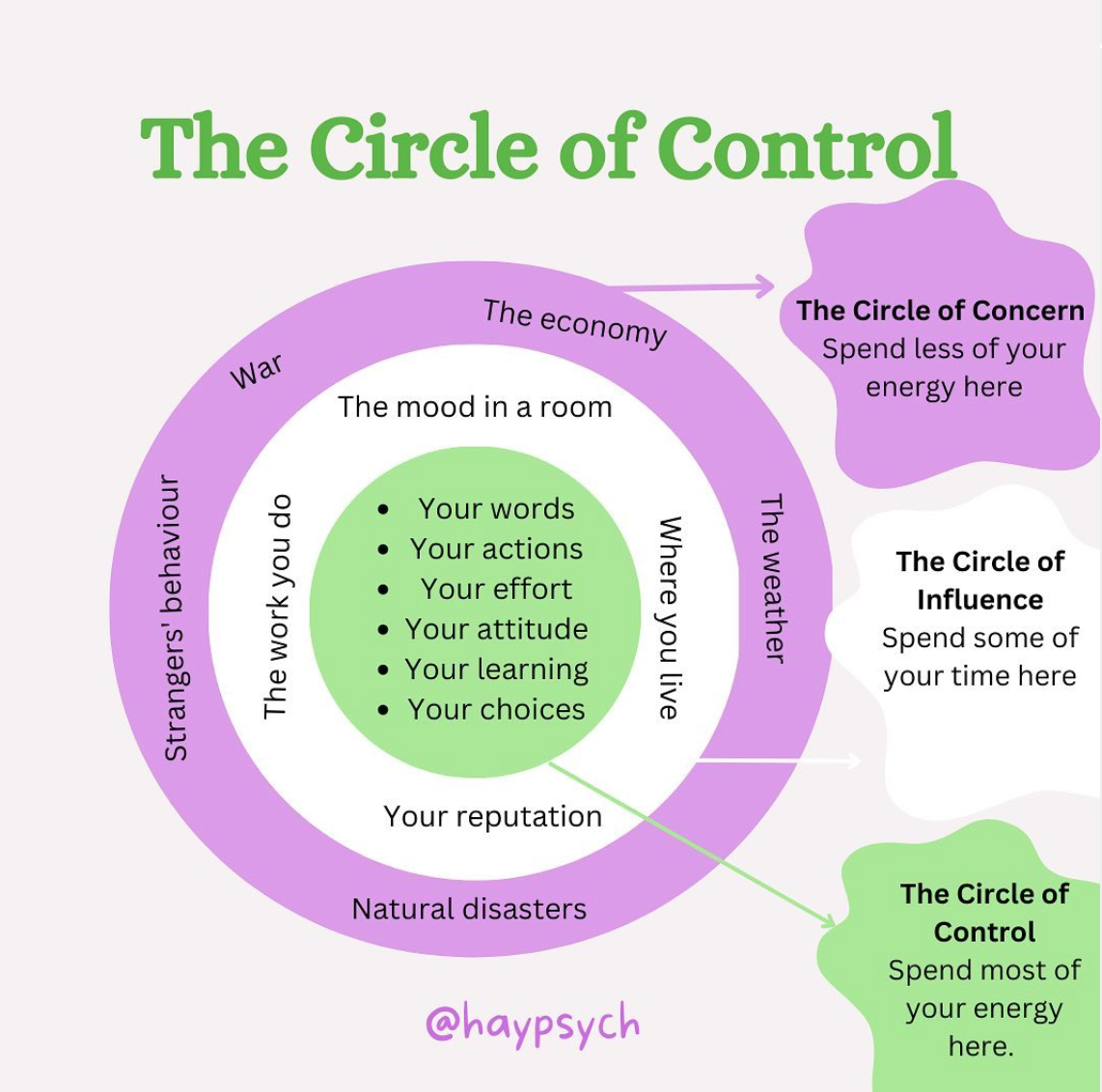
Some of the actions you can take to deal with job uncertainty are:
1. Self-compassion
Be kind to yourself. You may feel mixed emotions; fear, confusion, panic, and perhaps even hope that you are one of those who will be made redundant. These are all perfectly normal emotions, acknowledge the feelings and spend time processing them. There may even be a period where you try to assign meaning behind the redundancies and that it is somehow your fault (your performance, you should not have moved teams, if you had done X this wouldn’t have happened, etc.).
Talk to yourself as you would a friend in these scenarios. How would you comfort a good friend? What would you say to them if they felt this is their fault? Dr. Kriston Neff describes self-compassion as the following:
Mindful awareness of emotional and mental states
Understanding that suffering and failure are part of the shared human condition
An ability to exercise self-kindness, which entails being gentle, supportive, and understanding of oneself
2. Self-awareness and reflection
I suggest spending time understanding what you want next in your career, try to set aside the potential lay-offs/ uncertainty for this exercise (difficult – I know!). Here are some questions to start reflecting on:
Figure out your ‘why’ – what is it about work that brings you a sense of meaning or purpose?
When in your job do you feel energised? What tasks leave you feeling depleted?
What are your personal values?
What is your personal measure of career success?
What are your greatest achievements?
What are your main strengths?
What skills do you possess?
When you know the answers to these questions it is easier to understand what you want from your career. Having a better understanding of self will allow you to take control of your career and if you are made redundant (or some other career shock), then you will have a far better idea of what you want to do next.
3. Networking
Move into the circle of influence by building your network. Reach out to former colleagues, create or join networks and talk to friends who are in similar situations. There are some people who find networking difficult, perhaps you think it’s a bit ‘salesy’ or selfish. The best piece of advice I ever received about networking was to think of it as helping people. Where can you make connections and stay in touch with people so you can help them in the future (& who knows, they may help you too!)?
It’s often our ‘weak ties’ that prove most helpful when seeking new career opportunities. I certainly found this was true when I set up my business last year. I was initially surprised, then grateful when former colleagues from my first jobs or friends-of-friends offered their help and guidance.
4. Surrender!
This option is for the brave and laid-back among us, accept that you can not control the outcome, and surrender to the process. You trust that you have the resources and ability to manage the outcome, whatever it is.
Surrendering is not easy, we are told we need to ‘control’ situations and constantly have plans. It does not mean doing nothing, but instead it is ‘being’ with the process. Mindfulness, yoga, and meditation could help you with this process.
I hope these tips help you manage career uncertainty when it happens. I would love to hear if there are any other tips that you recommend that have helped you manage any career shocks such as redundancy, personal illness, closure of your employer etc.
“Letting there be room for not knowing is the most important thing of all. When there’s a big disappointment, we don’t know if that’s the end of the story. It may just be the beginning of a great adventure. Life is like that. We don’t know anything. We call something bad; we call it good. But really we just don’t know.”
– Pema Chodron


